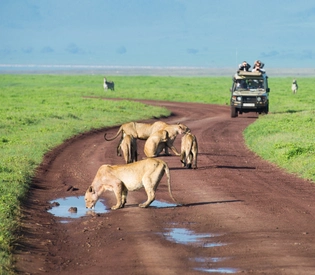
This 7-day travel itinerary focuses on the short-grass plains of the Southern Serengeti and the Ndutu region within the Ngorongoro Conservation Area, capturing the peak of the Great Migration calving season. Designed for wildlife enthusiasts, photographers, and luxury naturalists, this expedition pairs high-density big cat sightings with the birthing season of over 500,000 wildebeest calves.
Your Tanzanian adventure begins upon arrival at Kilimanjaro International Airport, where you will be met and greeted by your safari representative before transferring to Arusha. In Arusha, you will enjoy a hot sit-down lunch before taking a leisurely afternoon drive toward the Lake Manyara region. You will arrive at your lodge in the late afternoon to check in, relax, and enjoy dinner before your overnight stay.
Following breakfast at the lodge, you will pick up packed lunch boxes and set off for a morning game drive in Lake Manyara National Park, famous for its lush groundwater forest and diverse birdlife. In the afternoon, you will exit the park and drive up the Great Rift Valley escarpment into the Ngorongoro Conservation Area. Upon reaching the crater rim, you will check into your lodge for dinner and an overnight stay.
After breakfast, you will collect lunch boxes and descend into the breathtaking Ngorongoro Crater for a full-day wildlife safari. You will explore the crater floor, enjoying a picnic lunch in the wild while tracking the Big Five and immense herds of herbivores. In the late afternoon, you will ascend the crater walls and return to the lodge for an evening of relaxation, dinner, and an overnight stay.
You will start the day with breakfast before collecting packed lunches and setting off for the famous Ndutu region, situated within the Ngorongoro Conservation Area. Upon arrival in Ndutu, the heart of the Great Migration calving grounds, you will immediately embark on an afternoon game drive across the sweeping plains. Afterwards, you will head to your tented camp to settle in, enjoy dinner, and spend the night.
With breakfast finished and packed lunch boxes in hand, you will head out for an active morning game drive across the Ndutu plains. The day is dedicated to tracking wildebeest herds with their young calves and observing predator-prey dynamics, with a mid-day picnic lunch served in the bush. In the evening, you will return to the tented camp for dinner and your overnight stay.
You will enjoy breakfast and collect lunch boxes before setting out for another day of game drives across different sectors of the Ndutu area. The afternoon continues with wildlife viewing and exploring the seasonal marshes and open grasslands where thousands of newborn calves gather. You will return to the tented camp in the evening to unwind, share safari stories over dinner, and enjoy your final night in the wilderness.
After breakfast at the camp, you will be transferred to the Ndutu Airstrip for a short scheduled domestic flight back to Arusha Airport. Upon landing in Arusha, a representative will meet you and transfer you into town for a hot lunch. Following lunch, you will be driven to Kilimanjaro International Airport for your evening outbound flight home.
Frequently Asked Questions
The calving season spans from late December through March, with the absolute peak window occurring during February. In January, the vast migrating herds settle across the southern plains as the early wave of births begins. February brings the synchronized birthing peak, where thousands of calves are dropped daily in the open grassland, triggering constant predator action. By March, the young calves have gained sufficient strength and agility, and the herds begin their gradual movement northward and westward toward the Central Serengeti as the southern pastures dry up.
The primary focal point of the calving action centers around the Ndutu region, which straddles the boundary between the Ngorongoro Conservation Area and the Southern Serengeti. Key vantage points include the plains surrounding Lake Ndutu, Lake Masek, and the Naabi Hill entrance area. Staying in mobile tented camps on the Ngorongoro Conservation Area side of Ndutu is particularly advantageous because safari guides are permitted to drive off-road in this area. This off-road access allows visitors to track the mobile herds closely across open plains and witness birthing scenes or predator hunts from an exceptional proximity.
Beyond observing newborn calves learning to walk within minutes of birth, travelers will witness extraordinarily high levels of predator activity. Big cats such as lions, cheetahs, and leopards, alongside scavengers like hyenas and jackals, patrol the fringes of the herds looking to take advantage of vulnerable prey. Additionally, this period falls within the green season, making it a paradise for birdwatchers as thousands of migratory bird species arrive from Europe and Asia. Zebras and Thomson's gazelles also give birth alongside the wildebeest, filling the plains with young animals across multiple species.
While the famous river crossings between July and October feature high-stakes river obstacles, crocodiles, heavy dust, and dense crowds in the Northern Serengeti, the calving season offers a completely different atmosphere. Visiting between January and March provides lush green landscapes, clear air with minimal dust, wide-open views across unobstructed plains, and massive herd concentrations. The drama during calving season unfolds on open ground rather than in water, offering intense land-based predator hunts with generally fewer vehicle clusters than those found around the northern river banks.
The calving period coincides with Tanzania's green season, characterized by warm daytime temperatures, crisp early mornings, and lush vegetation punctuated by occasional afternoon showers. Travelers should pack lightweight, neutral-colored clothing for warm afternoon game drives, layered with a fleece jacket or sweater for chilly morning starts. A waterproof rain jacket is essential for unexpected tropical downpours, and packing a pair of high-quality binoculars alongside a camera equipped with a telephoto lens ensures you can capture wide-angle vistas and distant predator action across the expansive short-grass plains.